

If you’ve been to a chiropractor before and walked out of the office with your neck cracked, your back twisted, and a bill for “the adjustment that’s going to hold this time,” you already know why a lot of people in Fort Wayne are curious about something different. NUCCA is that something different. At Atlas Chiropractic of Fort Wayne, it’s the only technique we use. No twisting or popping. No wrenching the neck in a direction it doesn’t want to go. Just precise measurement and a gentle correction at a calculated angle, with follow-up that depends on posture rather than another round of X-rays every few months.
Here’s what actually separates NUCCA from the chiropractic care most people picture when they hear the word.
The Core Difference: One Bone Changes Everything Above and Below It
NUCCA stands for the National Upper Cervical Chiropractic Association. The technique focuses almost entirely on one vertebra: the atlas, or C1. That’s the ring-shaped bone at the very top of your spine that holds up the weight of your skull.
The atlas is unusual. Most vertebrae in your spine have facet joints that interlock with their neighbors. The atlas doesn’t. It’s built for rotation and balance, which means when it shifts out of alignment, the rest of the spine compensates to keep your eyes level with the horizon. That compensation shows up as one shoulder sitting higher than the other, a hip that rides forward, a head that tilts slightly, or chronic tension that never fully resolves no matter how many massages or stretches you try.
Traditional chiropractic typically treats the spine in segments, adjusting wherever joints feel stuck or restricted during that visit. NUCCA takes the opposite approach. Correct the atlas with precision, and the rest of the spine often releases on its own because the reason it was holding tension has been removed.
Measurement First, Adjustment Second
This is where NUCCA parts ways most dramatically with the snap-and-pop version of chiropractic.
Before any correction happens, a NUCCA-trained doctor takes a specific series of X-rays of the head and neck using low-radiation techniques and specialized filtering. Those images are then analyzed mathematically to determine the exact angle and direction of your atlas misalignment, which is unique to you.
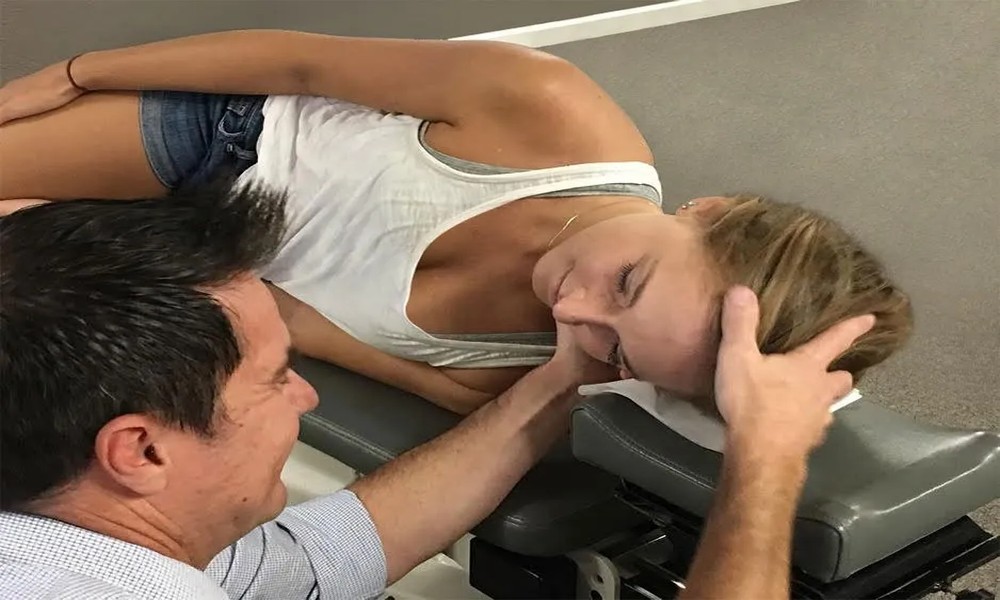
The adjustment that follows isn’t a generic technique applied to everyone who walks in. It’s calculated from your measurements. The doctor positions your head at a specific angle, places a hand just below the tip of your ear, and applies a light, controlled pressure along the exact vector the X-ray analysis indicated. Most patients describe it as feeling like someone leaning on them for a second or two. There’s no crack. There’s no jolt. That’s the entire correction.
Why So Little Force Works
Because the atlas doesn’t lock into facet joints, it moves under light pressure when the angle is right. NUCCA essentially uses leverage, the way a wheelbarrow moves a load of bricks that would be impossible to lift by hand. Once the atlas shifts, the head re-centers over the neck and the body unwinds its compensation pattern.
What Your First Visit at Atlas Chiropractic Looks Like
At our Fort Wayne clinic, a new patient appointment has a predictable flow:
- A full consultation covering your health history, previous injuries, current symptoms, and the goals you have for care
- Digital imaging of your upper cervical spine, used to calculate the precise nature of your misalignment
- A postural assessment that establishes a baseline we can recheck on future visits without needing repeat X-rays
- Your first correction, if the imaging shows you’re a candidate for NUCCA care
- A walk-through of what to expect in the days after, which for most patients involves noticeable postural changes and, often, a reduction in the symptoms that brought them in
Dr. Emily Staples handles each step personally. The purpose of the first visit isn’t to sell you a long care plan. It’s to find out whether your problem is something NUCCA can actually help with, and to say so plainly either way.
Who Tends to Do Well With NUCCA Care
NUCCA has a solid track record with the kinds of stubborn issues that don’t respond to conventional approaches:
- Chronic migraines and tension headaches that haven’t resolved with medication or standard chiropractic
- Post-concussion symptoms, including brain fog, dizziness, and persistent neck stiffness
- Vertigo and balance problems
- Whiplash injuries, especially those more than six months old
- Chronic neck and upper back pain with a clear postural component
- Sciatica and low back pain connected to a shifted pelvis that traces back to the neck
It’s also a good fit for patients who simply don’t want forceful manipulation. That includes older adults, people with osteoporosis concerns, anyone nervous about traditional adjusting, and parents looking for a gentler option for their kids.
NUCCA isn’t the right answer for every condition. If imaging shows no atlas misalignment, or if your problem is structural in a way that needs a medical specialist, we’ll tell you so and point you where you should go next.
Ready to See Whether NUCCA Fits Your Situation?
The clearest way to find out whether your chronic pain or postural issue is tied to an atlas misalignment is to get measured. At Atlas Chiropractic of Fort Wayne, the initial consultation is complimentary and the imaging is painless. You’ll leave that first appointment knowing whether NUCCA is a realistic path forward for you, and if so, what the care plan looks like.
Book online any time, including at two in the morning when your neck is keeping you up, and we’ll be ready for you at your scheduled slot. For background on the research behind the technique, nucca.org maintains an overview of the clinical work the Upper Cervical Research Foundation has published since 1971.
