

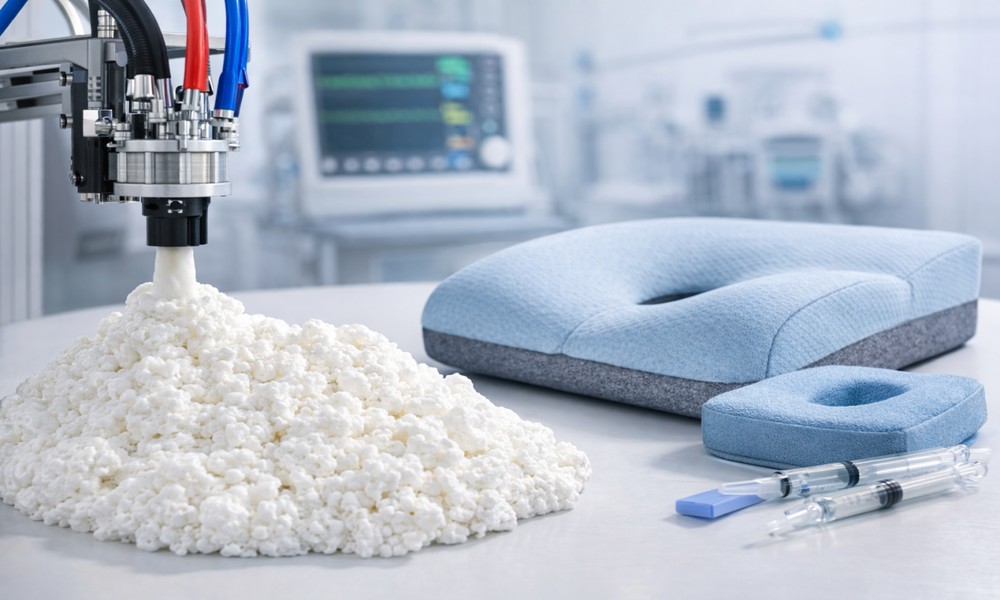
Modern healthcare relies not only on advanced medical knowledge but also on the development of high-performance materials. Among these materials, polyurethane (PU) has become one of the most important polymers used in the medical field.
From medical tubing and wound dressings to hospital mattresses and diagnostic equipment components, polyurethane plays a critical role in ensuring durability, comfort, and safety.
Because polyurethane can be engineered with different densities, flexibility levels, and chemical resistance properties, it offers manufacturers a versatile solution for producing reliable medical products.
In recent years, improvements in polyurethane processing technology and PU production equipment have further expanded the range of healthcare applications.
Why Polyurethane Is Widely Used in Medical Applications
Polyurethane is widely valued in the healthcare industry because of its unique combination of mechanical and chemical properties. Unlike many traditional plastics or rubber materials, polyurethane can be customized to achieve both softness and strength.
Several key properties make polyurethane especially suitable for medical environments.
1. Excellent Flexibility
Many medical products require materials that can bend without breaking. Polyurethane is extremely flexible and can be formulated to behave similarly to soft rubber. This makes it ideal for medical tubing, catheters, and flexible connectors used in hospitals.
2. Biocompatibility
Medical-grade polyurethane can be designed to be biocompatible, meaning it does not cause harmful reactions when in contact with the human body. Because of this property, it is commonly used in devices that interact directly with patients.
3. High Durability
Polyurethane materials resist abrasion, repeated stress, and environmental degradation. Medical equipment often undergoes frequent cleaning and long operating cycles, so durability is essential.
4. Chemical Resistance
Hospitals use disinfectants and cleaning agents regularly. Polyurethane maintains its integrity when exposed to many chemicals, helping medical devices remain safe and reliable.
Common Medical Devices That Use Polyurethane
Polyurethane materials appear in a wide variety of healthcare products and medical equipment. Many of these applications are not immediately visible but play a crucial role in daily medical operations.
Table 1 – Typical Medical Applications of Polyurethane
|
Application |
Description |
Key Advantages |
|---|---|---|
|
Medical tubing |
Used for fluid transfer, IV systems, and catheters |
Flexible and kink-resistant |
|
Hospital mattresses |
PU foam used in pressure relief beds |
Comfort and durability |
|
Medical device housings |
Protective components for diagnostic equipment |
Impact resistance |
|
Wound dressings |
Breathable polyurethane films |
Moisture control |
|
Orthopedic cushions |
Foam supports for rehabilitation |
Pressure distribution |
One of the most well-known uses of polyurethane in healthcare is medical foam cushioning. Hospital beds and wheelchair cushions often use polyurethane foam to reduce pressure on the body and help prevent pressure ulcers.
Polyurethane Foam in Medical Comfort Products
Comfort and patient care are extremely important aspects of modern healthcare. Polyurethane foam provides an effective way to produce supportive and ergonomic products.
Medical foam cushions and mattresses are designed to distribute body weight evenly. This helps reduce pressure points and improves patient comfort during long recovery periods.
Table 2 – Benefits of PU Foam in Medical Support Products
|
Feature |
Benefit in Healthcare |
|---|---|
|
Pressure distribution |
Reduces risk of pressure sores |
|
Lightweight structure |
Easy to transport and install |
|
Breathable foam cells |
Improves air circulation |
|
Long service life |
Durable for hospital use |
Many orthopedic pillows and rehabilitation supports also rely on memory foam technology, which is based on specialized polyurethane formulations. These products adapt to the shape of the body and help support proper posture during rest or recovery.
How Polyurethane Medical Materials Are Manufactured
The performance of polyurethane medical components depends not only on the raw materials but also on the precision of the production process. Polyurethane materials are typically produced through a chemical reaction between polyols and isocyanates, which creates a polymer structure with controlled density and elasticity.
To ensure consistent quality, manufacturers rely on specialized PU foaming machines. These machines control parameters such as temperature, pressure, and material ratios, which directly affect the final product properties.
Modern production equipment allows manufacturers to create polyurethane components with high precision and repeatability. For example, advanced PU foam machines can maintain accurate mixing ratios and stable injection performance, ensuring uniform foam structure and reliable mechanical properties.
Companies like Yongjia, known for manufacturing polyurethane equipment and processing systems, provide industrial solutions that support the production of various polyurethane materials used across industries-including healthcare-related products such as medical foam cushions and protective components.
By combining high-quality raw materials with reliable processing technology, manufacturers can produce polyurethane materials that meet strict performance and safety standards.
Future Trends of Polyurethane in Healthcare
As medical technology continues to evolve, the demand for advanced materials is growing rapidly. Polyurethane is expected to play an even greater role in future healthcare innovations.
Several emerging trends are shaping the future of polyurethane in medical applications.
1. Smart Medical Materials
Researchers are developing polyurethane materials with improved responsiveness and adaptability. These materials may respond to temperature or pressure changes, enabling more advanced medical devices.
2. Lightweight Medical Equipment
Polyurethane’s combination of strength and low weight makes it ideal for portable medical devices and wearable healthcare technology.
3. Improved Medical Foam Technology
New formulations are improving breathability, comfort, and long-term durability in medical foam products.
4. Sustainable Polyurethane Materials
There is increasing interest in environmentally friendly polyurethane systems, including bio-based polyols and recyclable materials.
Conclusion
Polyurethane has become one of the most versatile materials in modern healthcare manufacturing. Its flexibility, durability, chemical resistance, and comfort properties make it ideal for a wide range of medical devices and healthcare products.
From medical tubing and protective housings to hospital mattresses and orthopedic supports, polyurethane materials help improve both medical performance and patient comfort.
Behind these products lies advanced manufacturing technology. With the support of precision PU foam machines, manufacturers can consistently produce high-quality polyurethane materials for healthcare applications.
